Run your company on facts, not feelings.
Shugyo helps leaders sense the organization and improve its decision rhythm. Start with your context and a business-shaped ontology, then connect the evidence needed for the first decision.
You know something is off.
Invoices stuck. Onboarding delayed. Teams misaligned. Your data is scattered across systems and reports arrive late. By the time you understand the problem, it has already changed.
You are making decisions with yesterday’s visibility.
A shared, factual view of reality.
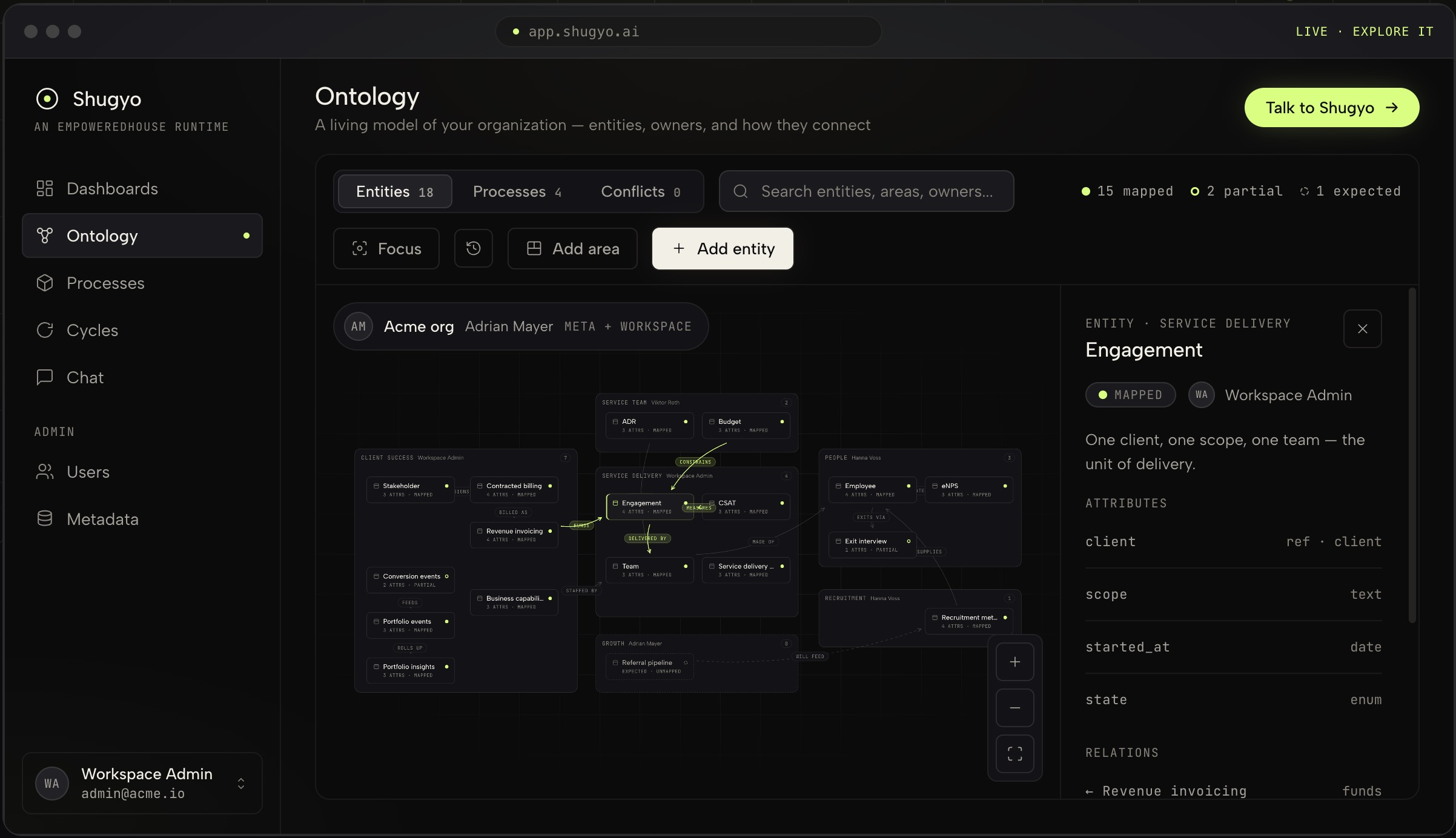
Shugyo connects your systems and builds a digital twin of your organization: a queryable model of how work flows.
Not another dashboard. The ground truth your dashboards were supposed to give you.
“We should probably improve our hiring process.”
The first is a discussion.Average time-to-hire is 47 days against a 28-day benchmark. 32% of the delay sits between interview scheduling and feedback, roughly €15,000 a month in lost productivity.
The second is a decision.See the work and keep decisions tied to it.
Observe
Compare each process with its documented design.
Measure
Calculate the time and money lost at each bottleneck.
Monitor
Get alerted the moment something deviates from the norm.
Decide
Give decision makers current evidence from the same source.
Run the rhythm
Use the twin in each operating review, make a decision, and measure what changes.
Start with the decision. Build the evidence around it.
Leaders define the context first. First insights arrive in 6–8 weeks, then teams use the twin in each operating review.
Leaders name the first decision, the people involved, and the business terms that matter.
Shugyo drafts the ontology for your team's approval, then connects the ERP, CRM, database, or spreadsheet records needed for the first decision.
The digital twin goes live, so your team can ask questions in plain language and inspect how work flows.
At each scheduled review, use the twin to make a decision and track how the organization responds.
Define what you need to learn.
Choose the method that matches the decision at hand. You can follow an object through a process, test whether an activity affects an outcome, or measure progress toward a goal.
Track where objects stall as they move through each state.
Test whether an activity changes the expected outcome.
Measure progress toward a target by its due date.
Works with what you have.
Shugyo connects to your existing tools. The twin reads data from those systems without changing the way your team uses them.
Answers for each leadership role.
Operations leaders
Locate delays and calculate their financial cost. Use the same evidence to decide what to change.
- Process visibility
- Bottleneck cost in dollars
- The case for change
Founders & CEOs
Compare management reports with current operational data before making a strategic decision.
- Strategic visibility
- Decision confidence
- Operational reality
Finance leaders
Find where cash stalls and calculate the cost of the process. Plan against recorded performance.
- Where cash gets stuck
- Process cost analysis
- Planning on facts
Turn process data into a management routine.
Each stage adds a more useful view of the work. Most teams can reach the measured stage within weeks.
A problem is visible, but its location and cost remain unclear.
The process is visible, including where delays occur.
Teams quantify impact and use tracked KPIs in decisions.
A regular review cadence shows the effect of each decision and exposes trends early.
Continuous improvement becomes part of regular management.
AI needs a model of your business.
Give the model a map of the business.
A chatbot can query individual systems through MCP plugins, but questions that span those systems need a shared model and access to the full dataset.
Shugyo builds an ontology: a semantic catalog shaped around your business objects, relationships, authority, and decisions. It can connect BigQuery or other useful evidence sources, then gives AI the approved model behind each answer.
A shared business model
The ontology attaches the relevant context to each request. The AI can then use relationships across systems.
Natural language queries
Ask a question in plain language. Shugyo writes SQL against the approved model and returns the result.
Traceable answers
Each answer shows how it was produced and links back to its source data.
Our working principles.
Use observable facts
We compare reports and opinions with the work recorded in source systems.
Ethics first
We protect trust and human dignity, even when that means refusing the work.
Choose technology carefully
We consider who benefits, who carries the risk, and whether the tool belongs in the process.
Responsible implementation
We improve a working business without disrupting the parts that already serve it well.
Experiment with accountability
We make experiments visible and keep our deadlines. When we are uncertain, we say so.
Make the next change easier
A useful definition or process should reduce the effort needed for the next improvement.
What customers say
We stopped debating whose spreadsheet was right. The constraint is visible now.
Shugyo finds the problem worth solving. Process Native Software solves it.
Shugyo is the intelligence leg of EmpoweredHouse. It gives leaders a current view of the work for regular operating reviews. When the evidence supports bespoke software, the Process Native Software shapes the contract and EHOS governs execution and evidence.
The numbers show whether custom software will pay for itself.
Shugyo fits these operating teams.
- Growing professional services and operations-heavy SMBs
- Roughly 50 to 300 people, $10M to $100M in revenue
- Already running a CRM and ERP, but lacking integrated intelligence
- Enterprises with Palantir or Celonis budgets
- Businesses under 20 people, or without digital systems
- One-time project work
See where the work gets stuck.
Early access is limited and includes hands-on setup. Bring us a process that needs a clearer view.